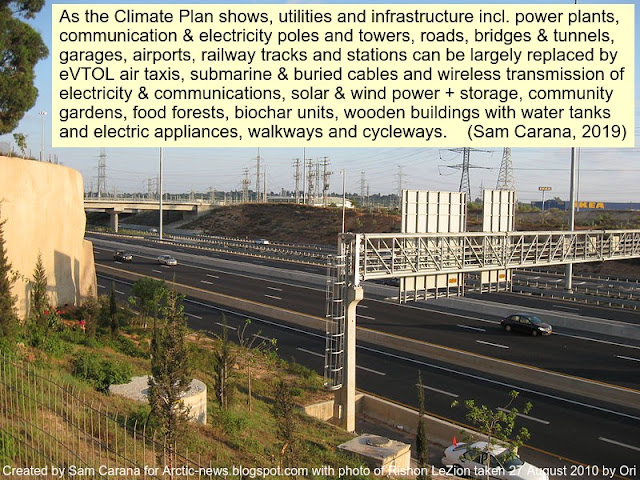
Rethinking Urban Design
 |
| [ image from a 2019 analysis ] |
Such redesign should include the location for buildings and traffic infrastructure such as roads and railways, bridges, tunnels, streetlights and traffic lights.
This should also include infrastructure for essential services such as poles, masts and pylons carrying electricity and communications, sewerage works, stormwater drains, pipelines that carry water supply, fossil fuel, etc.
Furthermore, much of the electricity used by cities is currently generated by coal-and-gas-fired power plants and by nuclear power plants that are vulnerable to extreme weather and that depend on stable supply of water for cooling. Such facilities should be replaced rapidly by more robust alternatives, specifically clean, renewable energy facilities such as solar panels and wind turbines that have smaller footprints in regard to land and water use and emissions.
Electric VTOL air taxis can replace a huge part of the traffic that now needs infrastructure such as roads, railways including service stations, parking buildings and strips, bridges, tunnels, etc., as well as shipping infrastructure such as harbors and canals. If much of this traffic instead takes place by air taxis, then cities will have more space for gardens, outdoor dining, parks, markets, tree-lined footpaths, biketracks, etc.
This dramatic reduction in the need for traffic infrastructure also includes garages and further parking spaces that now come with buildings. Urban design can become more compact and houses can be built closer together, reducing the cost of land and enabling people to reach their destination quicker, either by walking or cycling, or by using air taxis that can bring people to their destination faster than by traveling by road or rail, or by using conventional aviation.
As a result, there can be a huge increase in efficiency, translating in huge economic benefits, and job and investment opportunities, while there will also be huge health benefits and huge reductions in emissions of greenhouse gases, black carbon and other aerosols, and precursors of ground-level ozone.
Earlier posted at:
https://www.facebook.com/groups/airtaxis/posts/726689201566923/?comment_id=727867441449099
Earlier posted at:
https://www.facebook.com/groups/airtaxis/posts/726689201566923/?comment_id=727867441449099
Also have another look at the post at:
Which policy can help EVs most?
https://arctic-news.blogspot.com/2019/10/which-policy-can-help-evs-most.html